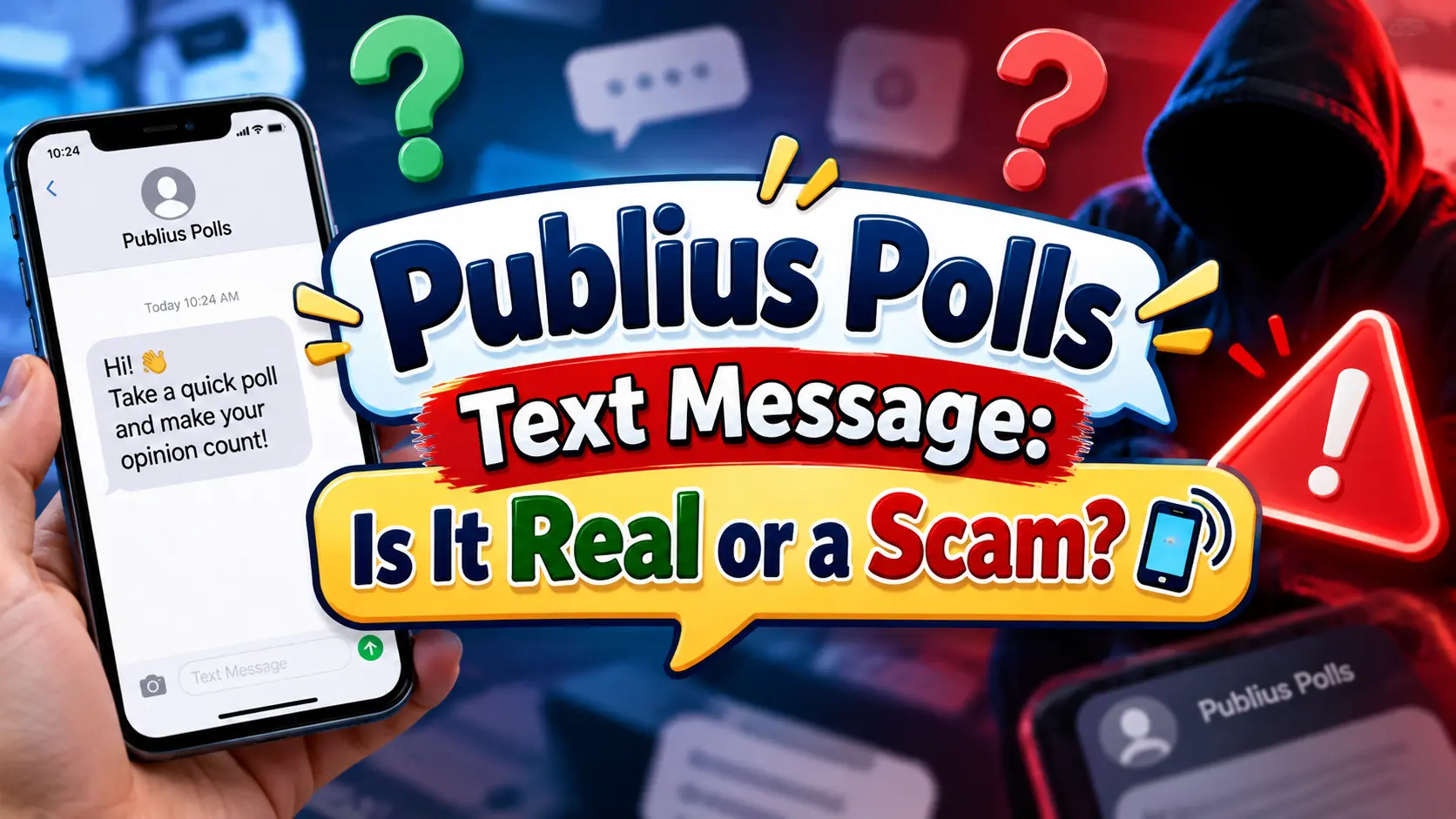
The Publius Polls text message can raise questions when it appears unexpectedly on your phone. You might wonder who sent it, why you received it, and whether you should respond. If the message mentions a political survey, public opinion, or an upcoming election, you may also question how the sender obtained your number. These concerns are understandable, especially when you receive unsolicited texts from unfamiliar organizations.
Before clicking a link or sharing personal information, take a moment to examine the message. The sender’s name alone cannot prove that a text is legitimate. Similarly, an unfamiliar message does not automatically mean someone has compromised your phone. Understanding the wording, checking the destination of any link, and recognizing common warning signs can help you make a safer decision. You should also know the difference between a genuine opinion poll, a promotional message, and a fraudulent attempt to collect information.
This guide explains the Publius Polls text message, the possible reasons it reached your phone, and the steps you can take to verify it. It also covers privacy concerns, suspicious links, survey participation, and ways to report unwanted messages. Whether you received one text or several, you can use these practical checks to decide what to do next. The goal is to help you protect your personal information without making assumptions about the sender. Because sender names can be copied or spoofed, verification matters more than the name displayed on your screen.
What Does a Publius Polls Text Message Mean?
A Publius Polls text message appears to be associated with a polling or survey-related sender, but the displayed name alone does not establish its identity. Check the message content, website, and contact details before trusting it.
For context, Publius Polls describes itself as a polling service that uses text messages to measure political opinions. Its website says it conducts rapid surveys about voter sentiment, candidates, and public issues.
The U.S. Federal Election Commission also lists a committee named PUBLIUS POLLS.
Those records establish that an organization with this name exists. However, they do not prove that every message displaying the name genuinely came from that organization.
📱 Why Did I Receive a Publius Polls Text Message?
There are several possible reasons for receiving an unsolicited political survey. Polling organizations may contact people to measure opinions about candidates, parties, elections, and public policies. Publius Polls says its approach relies on text-based surveys to collect responses quickly.
Your number might have been included in a survey outreach list, selected through a sampling process, or obtained through another contact source. However, without details about your particular message, there is no reliable way to determine how the sender obtained your number. Receiving the text does not prove that you registered for a survey or signed up for political messages.
🔎 Is the Publius Polls Text Message Legitimate or a Scam?
The answer depends on the specific message. Publius Polls has a public website and an identifiable presence in federal election records. Those facts alone cannot authenticate a text.
A message that asks you to rate a political party or candidate may be a survey invitation. A message requesting money, passwords, bank details, or sensitive identification information deserves much greater caution. Independent polling guidance also recommends checking the survey sponsor, the website address, and the questions before participating.
You do not need to respond simply because the text looks official. If you cannot independently verify the sender, ignore the message and avoid opening unfamiliar links.
🛡️ How to Check a Publius Polls Text Message Safely
Start by reading the entire message without clicking its links. Look for the sender’s name, the stated purpose of the survey, and any website included in the text. Then compare those details with information available through the organization’s independently located website.
The official website is. It provides information about its polling work and includes a contact section for people who have questions about receiving surveys or want removal from its list.
Visiting the website directly is safer than following an unfamiliar link in a text.
Also, inspect the survey questions. A neutral question about public opinion differs from a message designed to pressure you into donating money or revealing private information. Legitimate survey invitations should not require your bank password, payment card details, or Social Security number to record a political opinion.
If anything seems inconsistent, stop interacting with the message. You can contact the organization through independently verified details to ask whether it sent the invitation.
🔐 What Should You Do If You Receive Repeated Publius Polls Texts?
Repeated survey invitations can become frustrating, especially when you never requested them. Fortunately, you can take several practical steps to reduce unwanted contact without participating in the poll.
If the message appears genuine and includes an opt-out instruction, you can consider using it. Many survey messages provide a way to stop future texts. However, do not assume an instruction is trustworthy when the message contains suspicious links or other warning signs. You can instead block the sender and report the message through your phone’s messaging app.
On an iPhone, open the conversation and use the available sender-blocking or junk-reporting options. On Android, open the conversation and look for the block and report spam options. The exact steps depend on your device and messaging app.
If the texts continue from different numbers, avoid engaging with each new sender. Report suspicious messages to your mobile carrier when possible. In the United States, you can also forward unwanted or suspicious texts to 7726 (SPAM) when your carrier supports the service. For suspected fraud, the Federal Trade Commission provides reporting guidance.
🧠 Can a Publius Polls Survey Influence Your Political Opinions?
Political surveys can serve different purposes. Some measure public opinion, while others test how people react to particular statements, candidates, or policy proposals. Publius Polls describes its work as measuring voter sentiment and testing messaging for clients.
Pay attention to how a survey frames its questions. A neutral poll gives respondents room to express different views. A leading question may use emotionally charged wording or assume that a particular claim is true. Such wording can affect how people interpret the question and answer it.
You should also distinguish polling from political persuasion. A survey invitation may gather opinions, but a message can also use a question to introduce a political argument or encourage a later action. Read the wording carefully instead of assuming every text-based poll is impartial.
Your participation is voluntary. You can decline to answer, ignore the invitation, or stop responding whenever you feel uncomfortable. You can also compare political polling results with transparent surveys that explain their sampling methods, field dates, question wording, and sponsors.
Frequently Asked Questions About Publius Polls Text Messages
What is Publius Polls?
Publius Polls describes itself as a polling service that uses text messages to measure voter opinions and test political messaging. Its website discusses surveys involving candidates, public issues, and political sentiment.
However, the organization’s existence does not establish that every message using its name is authentic. Verify the specific text before responding.
Is the Publius Polls text message a scam?
Not necessarily. Publius Polls has a public website, and a committee under that name appears in Federal Election Commission records.
Still, those records cannot verify the sender of an individual text. Treat suspicious links, requests for money, and demands for sensitive personal information as warning signs.
Why is Publius Polls texting my phone?
The message may be part of a political opinion survey or voter research effort. The organization says it uses text-based polling to collect responses quickly.
However, the exact reason you received a particular invitation remains uncertain without further information. The text alone does not reveal how the sender obtained your number.
Should I respond to a Publius Polls text message?
You do not have to respond. If the message seems legitimate and you want to participate, verify the sender and read the survey questions first.
If the text contains suspicious links or requests private information, do not engage. Ignoring an unsolicited survey is a reasonable choice when you cannot establish its authenticity.
Can I reply STOP to Publius Polls?
If you believe the text is a genuine survey invitation and it provides an opt-out instruction, replying STOP may help end future messages. Read the message carefully before responding.
If you suspect a scam, consider blocking and reporting the sender instead. Remember that a reply cannot authenticate the sender, and you should never provide sensitive information to unsubscribe.
Does Publius Polls know my political affiliation?
Receiving a political survey does not prove that the sender knows your political affiliation. The organization may be seeking opinions from a broader group of people.
The available information does not establish how your particular number was selected or what information the sender holds about you. Avoid assuming that receiving a survey means someone has accessed your private accounts.
Can a Publius Polls text message access my phone?
Simply receiving an ordinary text message does not usually give its sender access to your phone. The greater risks arise when you open malicious links, install untrusted applications, or disclose sensitive information.
Keep your phone updated and avoid interacting with suspicious content. If you clicked a link and entered a password, change that password through the official website and review your account security.
How can I stop receiving Publius Polls messages?
You can block the sender through your messaging app and report unwanted texts as spam. If you believe the message is genuine, you can also consult the contact information on the official Publius Polls website.
If messages continue from new numbers, report them to your carrier. Avoid clicking unfamiliar links just to remove yourself from a list.
Conclusion
A Publius Polls text message may be an invitation to participate in political polling, but you should verify each message before trusting it. The organization describes its text-based survey work publicly, and federal records list a committee with the same name. Neither fact proves that an individual text is authentic. Check the sender, inspect the wording, and avoid sharing sensitive information. If the message seems suspicious or you simply do not want to participate, ignore it, block the sender, or report it. A cautious approach helps protect your privacy while allowing you to make an informed decision.

Ethan Brooks is a content writer specializing in messages, wishes and modern communication trends. He creates simple, engaging, and relatable content that helps people express their thoughts and emotions in the best way possible.